Table of Contents
Introduction
Once a treatment is complete and charted, the billing team must translate it into the proper code: was it varnish, or a different formulation? Fluoride varnish and other topical applications — gels, foams, rinses, tray-applied, paint-on — are both common and billed frequently in pediatric and general dentistry. However, they are reported using two different CDT codes, D1206 and D1208. Mixing them up leads to avoidable claim corrections that slow down routine preventive billing.
What Is CDT Code D1206?
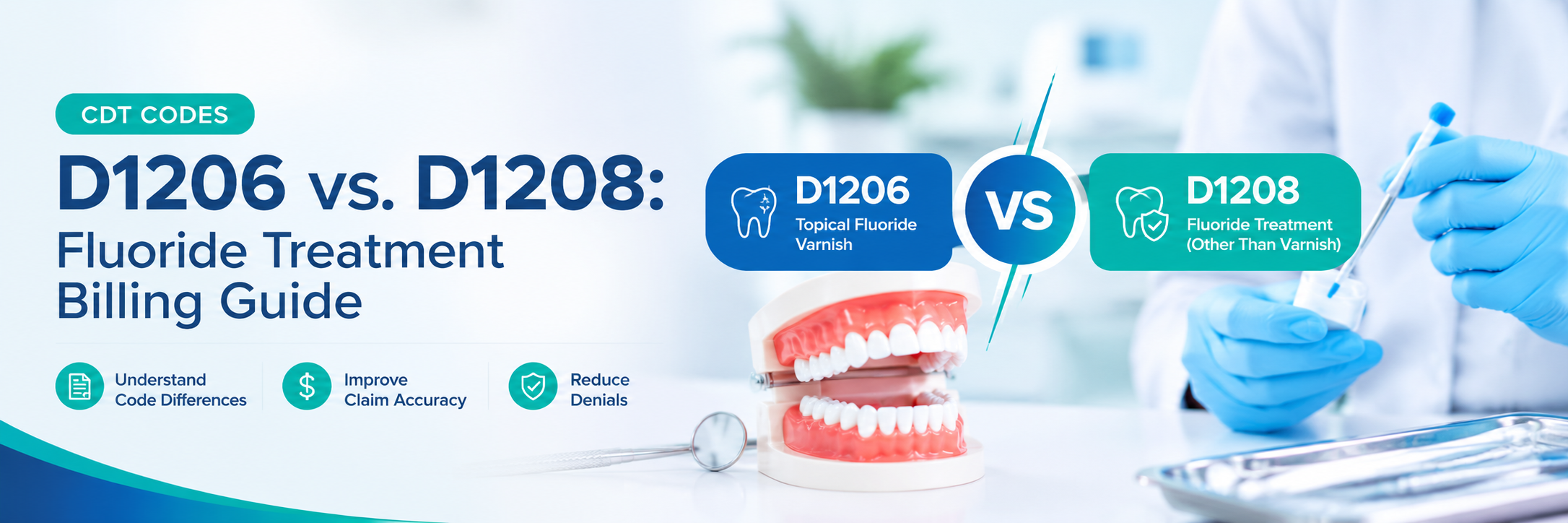
D1206 covers the topical application of fluoride varnish — a professionally applied, resin-based fluoride that adheres to the tooth surface and sets on contact with saliva. It is among the most frequently billed preventive codes in dental practices.
The billing task here is relatively straightforward: ensure that the clinical record specifically documents varnish rather than a non-varnish product, and that the submitted code aligns with what the chart describes. What that documentation needs to look like in practice — a brief note, a specific product name, or more — is not identical across every insurer, so this article outlines general best practices rather than a single universal rule.
What Is CDT Code D1208?
D1208 covers the topical application of fluoride, excluding varnish. This includes any professionally applied, prescription-strength topical fluoride that is not a varnish formulation (such as gel, foam, rinse, tray-applied, or paint-on fluoride). D1208 is not exclusively a "gel code"; it is defined by the exclusion of varnish.
Because multiple different non-varnish formulations fall under this single code, the billing team's documentation review should confirm which specific product or method was actually utilized. It is also important to note that take-home fluoride supplied to a patient for home use is reported under an entirely different code — confusing an in-office application with a take-home product is a separate common source of claim errors.
D1206 vs. D1208 Comparison Table
| Code | Procedure Category | Defining Distinction | Billing Team Should Verify | Common Reporting Risk |
|---|---|---|---|---|
| D1206 | Preventive — topical fluoride | Varnish specifically applied | Chart documents varnish, not a different formulation | Coding a gel or foam application as varnish by mistake |
| D1208 | Preventive — topical fluoride | Any professionally applied topical fluoride other than varnish (gel, foam, rinse, tray, paint-on) | Chart identifies the specific non-varnish product or method used | Assuming D1208 means “gel only,” or confusing it with take-home fluoride |
Common Fluoride Billing Errors
These represent realistic risk areas to review, though not every instance automatically triggers a denial, as payer rules vary.
| Problem | Why It Matters | Prevention Step |
|---|---|---|
| Code doesn't reflect the treatment delivered | Creates a mismatch between the chart and the claim | Confirm the specific fluoride product/method in the note before coding |
| Confusing varnish with a non-varnish application | D1206 and D1208 are not interchangeable | Check the product name or formulation documented, not just “fluoride applied” |
| Incomplete service documentation | Leaves the claim without support if questioned | Confirm the note states what was applied and that it was performed in-office |
| Missing or inaccurate treatment dates | Can trigger claim rejections independent of the code itself | Cross-check the date of service across chart, claim, and scheduling system |
| Not checking eligibility and benefits first | Coverage is a separate question from correct coding | Verify eligibility and benefits before or at the time of the visit when possible |
| Overlooking age or frequency limitations | Many plans cap fluoride benefits by age or visits per year | Check the specific plan's current limitations before submission |
| Assuming D1206 and D1208 have identical coverage | Plans may cover, limit, or exclude each differently | Verify each code's coverage separately under the applicable plan |
| Not reviewing the actual denial reason | Resubmitting without understanding the reason risks repeat denials | Read the specific denial code/explanation before correcting and resubmitting |
Documentation and Claim-Readiness Requirements
The table below describes what a billing team should generally review — not every payer requires every item, and some payers add requirements not listed here. Always confirm the applicable plan's current rules rather than assuming a single standard applies everywhere.
- Fluoride product/formulation: Confirm whether varnish or a non-varnish product (gel, foam, rinse, tray, paint-on) was used
- Service performed: Confirm the application was performed in-office, not supplied as a take-home product
- Date of service: Confirm accuracy and consistency with the chart and claim
- Patient and provider details: Confirm accuracy, including rendering provider where required
- Clinical record: Confirm the note supports the code submitted
- Benefit verification: Confirm eligibility and the specific plan's fluoride benefit before or at time of service
- Applicable plan limitations: Confirm age limits, frequency limits, and any same-day billing restrictions
- Payer-specific attachments: Confirm only where a specific, verified payer rule requires them — do not assume universally
Insurance Coverage and Payer-Specific Differences
Selecting the correct code — D1206 or D1208 — does not by itself guarantee insurance coverage. Benefit plans and state programs can differ meaningfully in eligible ages, frequency limitations, preventive benefit provisions, same-day billing rules, provider eligibility, required documentation, and reimbursement or exclusions. These differences are established by the individual plan or program, not by the CDT code descriptor itself.
As one verified, dated example: Delaware's Medicaid adult dental benefit lists both D1206 and D1208 as covered once every 12 months for beneficiaries age 21 and older, and specifies that only one of the two — not both — may be billed within that 12-month period. This illustrates exactly the kind of plan-specific rule that a correctly coded claim can still run into if it isn't checked first.
A Short Verification Workflow
Interactive Coding Comparison Tool
Which treatment was actually provided?
Interactive Pre-Submission Checklist
This is an educational workflow aid — not a substitute for professional coding judgment or payer verification.
Practical Scenarios
Scenario 1: Routine Preventive Visit
Scenario 2: Correct Code, Frequency Limit Denial
Working With Sirius Solutions Global
Accurate fluoride coding starts with the treatment actually performed — varnish reported as D1206, any other professionally applied topical fluoride reported as D1208. From there, successful claim handling also depends on documentation, eligibility verification, and attention to the specific plan's age, frequency, and reporting rules, which can differ by payer and by program.
Sirius Solutions Global supports dental practices with billing workflows, claim submission, denial management, and revenue cycle support, including recurring coding and documentation issues like varnish-versus-non-varnish confusion. This article is educational and does not promise a specific reimbursement outcome for any claim.
Frequently Asked Questions About D1206 vs. D1208
References and Further Reading:
ADA — CDT Code reference: https://www.ada.org/publications/cdt
ADA — CDT Coding Education: https://www.ada.org/publications/cdt/coding-education
ADA Dental Quality Alliance — 2026 Topical Fluoride Measures: https://www.ada.org/-/media/project/ada-organization/ada/ada-org/files/resources/research/dqa/dental-quality-measures/2026/2026_topical_fluoride_d_oh_doh_final.pdf
Delaware Medicaid — Adult Dental Benefit Codes and Descriptions (Delaware-specific adult benefit example, not a nationwide standard): https://dhss.delaware.gov/dmma/home/medicaid/adult-dental-codes/
Disclaimer: This article is provided for general educational purposes only and does not constitute dental, legal, coding, or billing advice for any specific patient, practice, or claim. CDT code descriptors and ADA guidance are updated periodically; payer policies, including the Delaware Medicaid example referenced above, are subject to change and apply only to the specific plan or program named. Always verify the current CDT edition and the applicable payer's current policy before submitting a claim. Sirius Solutions Global makes no guarantee regarding claim approval, reimbursement amounts, or audit outcomes, and this content should not be treated as a substitute for official ADA guidance, the applicable payer's policy, or independent compliance review.
CDT is a registered trademark of the American Dental Association. This article references and paraphrases publicly available ADA guidance for educational purposes and does not reproduce the full CDT Manual.