Table of Contents
Introduction
This specific procedural code defines a urinalysis executed via an automated reagent reader, strictly bundled with a separate microscopic evaluation of the sediment. Submitting this code requires irrefutable proof that the ordering provider explicitly requested the microscopy phase. If the order merely asks for a basic analysis, billing the more comprehensive code constitutes a massive compliance failure, regardless of what the lab technician actually did.
This manual details the rigid parameters of the procedure, highlights distinctions between manual and automated collection methods, outlines federal compensation scales for the 2026 fiscal cycle, and identifies the operational blind spots that routinely trigger audits and rejections.
What Is CPT Code 81001?
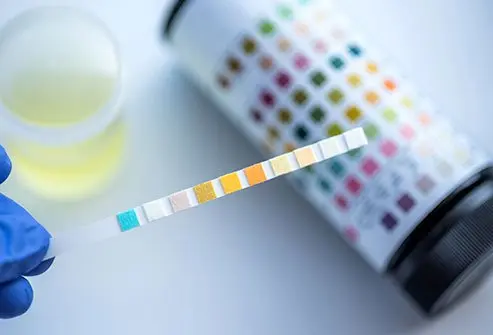
This identifier is reserved for a dipstick or reagent tablet analysis processed by a mechanical instrument, coupled with a distinctly separate microscopic inspection of the urine. Both the automated machine reading and the manual microscopic review must physically occur—and be heavily documented—to justify utilizing this code.
| Key Fact | Detail |
|---|---|
| CPT code | 81001 |
| Automated testing method | Dipstick/tablet reagent read by an automated instrument |
| Role of microscopy | A separate, additional sediment examination — must be performed and documented, not assumed |
| Code-selection consideration | The order must explicitly support microscopy; a generic “UA” order does not |
| Primary documentation consideration | Physician order/intent must match the service actually performed and billed |
Note: The information contained herein addresses strictly administrative billing architecture, not clinical diagnostic instruction regarding renal pathology or infectious disease.
CPT 81001 Billing Guidelines for 2026
Validating this specific line item requires looking past the laboratory's daily routine to examine the actual intent of the ordering physician. A robust internal audit should follow this logical progression:
- Audit the initial requisition to ensure it explicitly demands microscopy. A vague "urinalysis" request legally supports only the baseline, non-microscopic codes.
- Examine the internal laboratory ledger to guarantee an automated machine—not a human eye—read the dipstick.
- Verify that the clinical notes explicitly detail the findings of the microscopic sediment review.
- Audit the facility's CLIA certification tier. Codes bundling microscopy generally demand a Provider-Performed Microscopy (PPM) certificate or higher; a basic Certificate of Waiver is insufficient.
- Ensure the attached diagnostic markers definitively justify the clinical need for the analysis.
- Consult local carrier directives, as commercial networks routinely implement proprietary restrictions that bypass generic federal logic.
A clinic's internal mandate to "always check the sediment under the scope" does not grant authorization to bill the higher code. Only the doctor's explicit written request grants that authority.
CPT 81001 vs. 81000, 81002, 81003, and 81015
Utilizing the correct identifier depends entirely upon the reading method and the explicit inclusion of a microscope.
| Code | Process | Includes Microscopy? | Key Billing Distinction |
|---|---|---|---|
| 81000 | Non-automated dipstick | Yes | Manual visual read; mandates a PPM certificate or higher. |
| 81001 | Automated dipstick | Yes | Machine read; mandates a PPM certificate; physician order must explicitly demand microscopy. |
| 81002 | Non-automated dipstick | No | Manual visual read; typically falls under a standard CLIA waiver. |
| 81003 | Automated dipstick | No | Machine read; typically CLIA-waived (requires QW modifier); the default fallback code for a generic "UA" requisition. |
| 81015 | Microscopic examination of urine | N/A | A standalone code for microscopy. Federal unbundling algorithms explicitly forbid billing this alongside 81000–81003 for the identical sample. |
Selecting among these codes requires knowing exactly how the test was performed and exactly what the doctor ordered. If the physician jots down "UA," the clinic must default to the baseline codes (81002 or 81003). Upcoding to 81000 or 81001 based on a lab technician's extra initiative will absolutely trigger a federal audit.
CPT 81001 Documentation Requirements
Prior to transmitting an invoice, ensure your clinical records satisfy the following criteria:
| Review Item | What to Check | Why It Matters |
|---|---|---|
| Order/intent | Does it explicitly specify microscopy, or just “UA”? | Federal auditors view a generic order as legal authorization for the non-microscopy codes exclusively. |
| Automated method | Was the dipstick actually read on an automated instrument? | Separates the automated codes from the manual visual codes. |
| Microscopy performed | Are sediment findings documented in the lab record? | Absolutely mandatory to validate the higher-tier code. |
| CLIA certification | Does the lab hold the certification level required for microscopy? | A baseline Certificate of Waiver legally prohibits billing 81000 or 81001. |
| Diagnosis information | Does ICD-10-CM coding reflect the clinical indication? | Establishes the clinical justification for payment. |
| Payer-specific requirements | Has the applicable coverage policy been reviewed? | Carrier stipulations often diverge wildly from federal norms. |
If discrepancies exist between the doctor's request, the methodology used, and the drafted invoice, you must halt the billing cycle. Modifying clinical notes retrospectively to salvage an incorrect code is a severe compliance violation.
Medical Necessity and Diagnosis Coding
Securing compensation relies upon demonstrating a legitimate clinical need. The diagnostic marker attached to the file communicates the physician's rationale to the insurer. However, simply appending an accepted diagnostic code does not compel a carrier to release funds if their internal policies restrict the frequency or application of the assay. Billing teams should meticulously navigate federal databases to locate applicable Local Coverage Determinations governing urinalysis evaluations in their specific geographic sector.
CPT 81001 Reimbursement in 2026
These assays draw funding from the Clinical Laboratory Fee Schedule, a mechanism operating independently of standard physician compensation structures. Published federal directories for the 2026 cycle indicate a national baseline allocation of $3.17 for this specific automated analysis. Administrative teams must habitually cross-reference these static projections against live federal data portals, as regional contractors possess the authority to adjust pricing based on localized variables.
| CPT Code | Description | CY2026 CLFS National Rate |
|---|---|---|
| 81000 | Non-automated, with microscopy | $4.02 |
| 81001 | Automated, with microscopy | $3.17 |
| 81002 | Non-automated, without microscopy | $3.48 |
| 81003 | Automated, without microscopy | $2.25 |
| 81015 | Microscopic examination of urine | $3.05 |
Merely locating a procedural code on a federal directory does not ensure automatic funding. Stringent coverage rules, rigid bundling algorithms, and convoluted commercial contracts routinely suppress the final collected sum far below the initial billed charge. Commercial payers operate entirely independently of federal schedules and compensate at wildly different rates.
Common CPT 81001 Billing Errors and How to Prevent Them
Implement these safeguards to intercept routine administrative breakdowns.
| Common Error | Preventive Review Step |
|---|---|
| Billing 81001 when the order only supports 81003 | Read the requisition literally. A vague "UA" order legally defaults to the non-microscopic code. |
| Selecting a code inconsistent with the method actually used | Audit the lab printouts to confirm a machine—not a human—read the dipstick. |
| Adding microscopy because of an internal lab protocol, not an order | Enforce strict guidelines that billers cannot upcode based on laboratory habits. |
| Confusing CPT 81001 with 81000, 81002, or 81003 | Mandate that staff visually verify the physical processing log before drafting the invoice. |
| Billing 81001 and 81015 together for the same specimen | Deploy software scrubbers to isolate concurrent panel submissions on the same service date. |
| Incomplete or inconsistent laboratory documentation | Enforce a strict reconciliation between the requisition, the physical processing log, and the final results. |
| Unsupported or inaccurate diagnosis information | Ensure diagnostic markers directly correlate with the physician's documented rationale. |
| Overlooking applicable CLIA or payer requirements | Halt billing if the clinic's certification tier does not explicitly support microscopic evaluations. |
Claim Review Workflow
Utilize this interactive module to track your pre-submission audit. Caution: Resolving these checkpoints does not mathematically guarantee carrier funding.
Improve Your Laboratory Billing Workflow With Sirius Solutions Global
Mastering this specific code requires operational discipline: verifying the physical methodology, intercepting automatic upcoding, proving clinical necessity through pristine documentation, and aggressively balancing finalized payments.
Sirius Solutions Global delivers specialized revenue cycle oversight, helping clinical laboratories and healthcare networks intercept structural billing flaws, decode complex denial patterns, and recover stranded capital. We optimize administrative architecture without relying on fictitious financial guarantees.
Frequently Asked Questions
References and Further Reading:
CMS: Medicare NCCI Policy Manual: https://www.cms.gov/medicare/coding-billing/national-correct-coding-initiative-ncci-edits/medicare-ncci-policy-manual
CMS: Clinical Laboratory Fee Schedule (CLFS): https://www.cms.gov/medicare/payment/fee-schedules/clinical-laboratory-fee-schedule-clfs
CMS: Clinical Laboratory Fee Schedule Files: https://www.cms.gov/medicare/payment/fee-schedules/clinical-laboratory-fee-schedule-clfs/files
CMS: Medicare Coverage Database: https://www.cms.gov/medicare-coverage-database/
Noridian: Laboratory Services — Incorrect Billing: https://med.noridianmedicare.com/web/jeb/specialties/lab/incorrect-billing
Disclaimer: This overview is provided solely as an educational resource and does not replace official CMS coding manuals, carrier coverage bulletins, or qualified legal counsel. Billing decisions must be verified against current federal statutes and the patient's individual policy guidelines active on the date of service. Quoted reimbursement levels reflect publicly available Medicare datasets from late 2026 and are completely subject to regional adjustment or future amendment. Sirius Solutions Global accepts no liability for denied claims or compliance failures arising from the implementation of this material.