Table of Contents
Introduction
A podiatry visit involves paring five, six, or a dozen corns and calluses, and the billing team has to compress all of that into a single procedure code. Pick 11055 or 11056 instead of 11057, and the claim undercodes the visit. Pick 11057 without documentation showing more than four lesions, and it's an overcode that invites a payer audit.
CPT 11057 isn't simply "11056, but bigger." It has its own lesion-count threshold, its own documentation expectations, and the same routine-foot-care coverage hurdles that trip up the rest of this code family. This guide covers what CPT 11057 represents, how it compares to 11055 and 11056, what documentation supports it, and where claims tend to run into trouble.
CPT 11057 at a Glance
| Item | Details |
|---|---|
| CPT Code | 11057 |
| Procedure | Paring or cutting of benign hyperkeratotic lesions, more than 4 lesions |
| Specialty | Primarily podiatry; also billed by dermatology and other qualified providers |
| Coding Focus | Total lesion count treated in the encounter, not anatomical sites |
| Documentation Focus | Lesion count, location, type, and medical necessity |
| Billing Risk | Incorrect lesion count, insufficient documentation, routine foot care exclusions |
What Is CPT 11057?
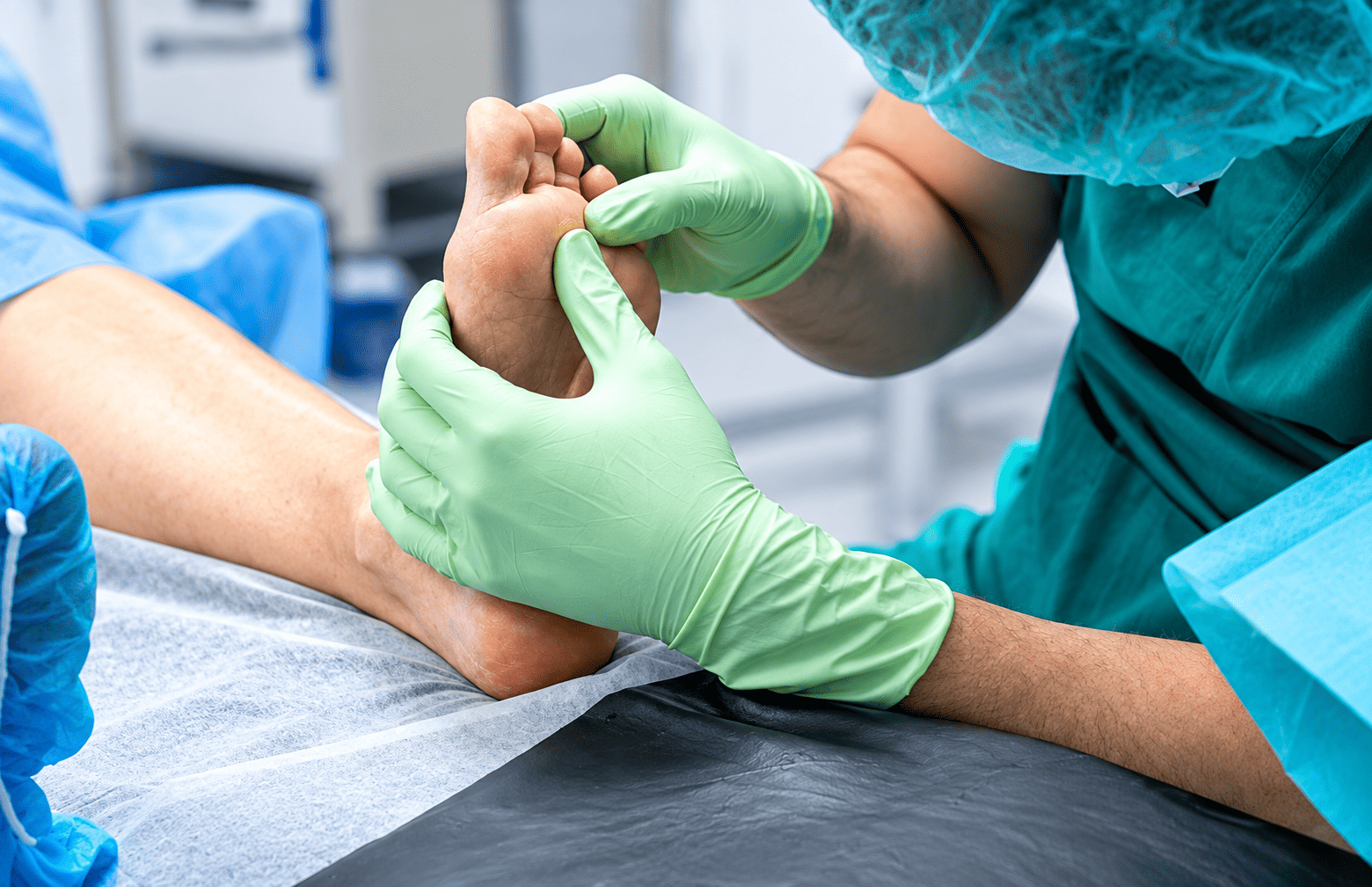
CPT 11057 describes paring or cutting of a benign hyperkeratotic lesion, such as a corn or callus, when more than four lesions are treated in one encounter, typically using a scalpel, curette, or similar sharp instrument. The procedure addresses hyperkeratosis, a buildup of thickened skin, rather than being a cosmetic trim.
The coding unit is the total lesion count for that visit, not the number of feet, sites, or separate complaints. A patient with six calluses across both feet in one visit is still one CPT 11057 claim line, not two. Correct code selection matters because the 11055-11057 family is bundled under NCCI: the codes are mutually exclusive, and billing more than one from the family for the same encounter, or using a modifier to bypass that edit, isn't appropriate.
CPT 11055 vs. 11056 vs. 11057
| CPT | Lesion Count | General Purpose | Key Billing Consideration |
|---|---|---|---|
| 11055 | 1 lesion | Paring/cutting a single corn or callus | Confirm only one lesion was treated before selecting this code |
| 11056 | 2 to 4 lesions | Paring/cutting a small cluster of lesions | Document each lesion's location to support the count |
| 11057 | More than 4 lesions | Paring/cutting a larger number of lesions in one visit | Documentation must clearly support a count above four |
Which Code Should You Use?
The correct code depends on the documented lesion count for that specific encounter, not on which code reimburses more. Selecting 11057 without a record that clearly supports more than four lesions is the kind of pattern payers flag during audits, and undercoding to 11055 or 11056 when more lesions were actually treated shortchanges the practice for work performed. The lesion count belongs in the clinical note at the point of care, before the claim is ever generated.
Before You Submit a CPT 11057 Claim
A defensible CPT 11057 claim generally reflects consistency across several documentation elements. Some of these are general best practice; others depend on the specific payer.
Pre-Submission Checklist
Not every item is universally mandatory; some, like class-finding modifiers, are payer- or MAC-specific rather than a blanket requirement. Confirm current expectations against the applicable payer policy rather than assuming one checklist covers every claim.
Medical Necessity
Medical necessity is one of the most consequential parts of billing CPT 11057, because lesion paring sits close to the line between a medically necessary procedure and routine foot care that many payers exclude. The diagnosis documented should accurately reflect the patient's condition, painful or symptomatic hyperkeratotic lesions, or lesions connected to a systemic condition, rather than being selected simply to satisfy a payer edit.
A supported diagnosis doesn't guarantee payment on its own. Coverage can still depend on the specific payer's policy and the patient's individual clinical circumstances, including whether the visit falls under a routine-foot-care exclusion or one of its documented exceptions.
CPT 11057 Billing Workflow
Modifiers
Modifier needs for CPT 11057 depend heavily on the payer and the clinical circumstances, so a generic modifier list isn't useful here. Two situations come up often enough to be worth flagging:
- Class-finding modifiers: Some payers, including Medicare in certain routine-foot-care exception scenarios, require a modifier reflecting documented systemic or vascular findings. These only apply when the underlying clinical findings are actually documented, not by default.
- Modifier 25 on a same-day E/M: If a significant, separately identifiable evaluation and management service is billed the same day as the lesion paring, that E/M typically needs modifier 25 with documentation supporting it as distinct from the decision to perform the procedure.
Because CPT 11055, 11056, and 11057 are bundled against each other under NCCI, a modifier is not an appropriate way to bill more than one of these codes for the same encounter. Applying a modifier incorrectly, whether to bypass a bundling edit or without supporting documentation, is more likely to create a claim problem than solve one.
Common CPT 11057 Billing Mistakes
| Billing Mistake | Consequence |
|---|---|
| Selecting the wrong CPT code for the lesion count | Claim may not reflect the service actually performed |
| Confusing 11055, 11056, and 11057 | Codes are mutually exclusive; a mismatch affects payment |
| Documentation that doesn't support the service | Medical necessity and lesion count may be difficult to establish |
| Diagnosis that doesn't establish medical necessity | Claim may be treated as excluded routine foot care |
| Ignoring payer-specific coverage rules | Claim may miss that payer's requirements |
| Incorrect modifier usage | May flag the claim for review or trigger a bundling edit |
| Submitting without a coding consistency review | Errors reach the payer instead of being caught internally |
| Assuming Medicare and commercial rules are identical | Payer-specific requirements may be missed |
| Failing to follow up on rejected or denied claims | Recoverable revenue goes unresolved |
| Treating every podiatry claim as if it follows the same rules | Payer-specific nuances get overlooked |
Before the Claim Leaves Your Billing System
A short, consistent pre-submission review is what actually reduces avoidable CPT 11057 problems. Five elements are worth checking on every claim:
Reviewing these five elements before submission won't eliminate every denial, but it catches the mismatches that are most within a billing team's control before the payer ever sees the claim.
Is Your CPT 11057 Claim Ready?
A quick self-check before submission:
| Question | Yes | No |
|---|---|---|
| 1. Does the documentation clearly support the billed service? | ||
| 2. Does the diagnosis information support medical necessity? | ||
| 3. Has the correct CPT code been confirmed against the lesion count? | ||
| 4. Have applicable payer rules been reviewed? | ||
| 5. Has the claim been checked for modifier and coding issues? |
If multiple answers are "No," the claim may deserve a second billing review before submission.
CPT 11057 Reimbursement
There's no single number that applies to every CPT 11057 claim. Payment depends on the payer, geographic locality, whether the claim is Medicare or commercial insurance, any contracted rate in place, coverage status for that specific encounter, documentation quality, medical necessity, claim accuracy, and correct modifier usage.
Reference the applicable Medicare fee schedule or payer contract directly for current, locality-specific figures. Reimbursement isn't guaranteed simply because the code is valid and the claim was submitted correctly.
Frequently Asked Questions
Disclaimer: Coding, coverage, reimbursement, and documentation requirements can vary by payer and may change over time. Practices should verify current CPT, CMS/MAC, and payer-specific policies before submitting claims. This article is for general educational purposes only and is not legal, coding, compliance, or billing advice for any specific claim, patient, or organization.
Sources Reviewed: Current CPT code descriptions for 11055-11057, CMS/NCCI bundling guidance for the paring-and-cutting lesion code family, and Medicare routine foot care coverage guidance. Practices should confirm current policy details directly with CMS, the applicable MAC, and the payer before billing.